Shanan Buckingham prosecuted the case by developing medical, forensic and treatment evidence and challenging the defense account of a command voice and lack of criminal responsibility. She cross-examined defense experts about their sources and objectivity and presented Avram Mack's opinion that Clancy retained the legally required capacities despite a major depressive episode.
Prosecution
Shanan Buckingham
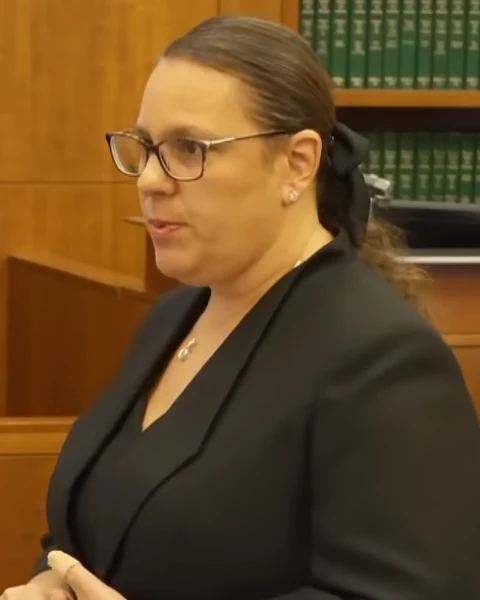
Assistant district attorney representing the Commonwealth in the prosecution of Lindsay Clancy.
Appeared2026 Criminal Trial
5,394 lines·82 proceedings·1 mention
About
Shanan Buckingham presented the Commonwealth's theory that Lindsay Clancy deliberately arranged time alone with her children, killed them and attempted suicide while remaining criminally responsible. In her Day 1 opening, she acknowledged mental health difficulties but disputed the reported command voice and argued that Clancy could appreciate wrongfulness and conform her conduct to law. Those were prosecution contentions, not findings.
Buckingham developed the physical and medical evidence through emergency responders and hospital clinicians. Her examinations addressed the children's condition and resuscitation, including Dawson's neck marks, and distinguished Clancy's superficial lacerations from serious spinal injuries. On redirect, she sought clarification of wound-depth terminology rather than treating every use of depth language as a severity assessment. ICU testimony also addressed resuscitation, later communication and improving post-extubation delirium, preserving distinctions between observations at different stages of care.
Her forensic examinations established how prescription bottles, blood samples, exercise bands and fingerprint evidence were handled. The court admitted bottle-related photographs and evidence on her motions. She elicited explanations for preserving limited shingle material for possible DNA analysis and for the absence of comparison-quality fingerprints. Toxicology questioning distinguished detection from concentration: witnesses described mostly therapeutic concentrations but limited what could be inferred about individual effects. Another examination established that the children's toxicology screens detected no substances. Buckingham also introduced journal evidence about sleep, anxiety and childcare strain, and developed surveillance timing and authentication of a parenting-related Facebook post, including limits on approximate travel estimates.
Buckingham compared outward behavior with reported symptoms rather than presenting lay observations as clinical diagnoses. Her examinations included favorable parenting accounts, apparently unchanged behavior at a school pickup, and a comparison of weight loss with demeanor and communication at a January gathering. Through treatment witnesses, she traced insomnia, anxiety, medication changes, diagnostic uncertainty, safety assessments and referrals for higher care. On Rebecca Jollotta's redirect, she addressed prescribing and continuity-of-care questions raised on cross-examination; Jollotta distinguished intrusive thoughts from a disclosed suicidal plan or intent. Latiesha Dukes described reported symptoms but no observed psychosis or need for emergency intervention.
During the defense case, Buckingham tested the reach of Margaret Hamp's and Susan Clancy's personal knowledge. Susan defended the family's childcare arrangements and qualified her recollections; her Thanksgiving account included both reported improvement and continuing difficulties. The judge instructed jurors not to consider Buckingham's question about murder as a mortal sin. Buckingham challenged Donald Condie's source review and medication interpretations. He resisted some dosing inferences but acknowledged limits on reported voice-hearing. Her cross-examination of Paul Zeizel focused on incomplete record review, medication-history errors, the source and timing of the command-voice account, and objectivity. Zeizel corrected a trazodone/Zoloft confusion but maintained that purposeful activity could coexist with psychosis. Hospital excerpts and his news-conference recording were admitted as Exhibits 283 and 284.
Buckingham presented psychiatrist Avram Mack's opinion that Clancy experienced a major depressive episode but retained the capacities required for criminal responsibility. On redirect, she returned to his evaluation methods and diagnostic reasoning; the recorded expert interview was admitted without objection. She also addressed challenges to the investigation and expert involvement. In a jury-out hearing, Dan Lawler told her he had not overheard the doctor and Clancy and knew of no evidence that Zeizel prompted the voice account; no substantive ruling appeared in that exchange. The judge later sustained her scope objection to a recross question. Her request for trial security-visit logs was limited by the judge to Zeizel. At the Day 21 charge conference, she opposed a Bowden instruction concerning investigative shortcomings, and the court denied that instruction.
Trial Record (82)
No proceedings match this filter.